Quantum Entanglement
This article is a follow up to Quantum Entanglement: The Future of Instant, Secure Communication
Remember when the “Quantum Internet” sounded like something straight out of a futuristic movie? Well, the future is now. While you won’t be browsing quantum-entangled TikToks on your phone tomorrow, the global race to build this revolutionary network is in full swing, driven by astonishing breakthroughs in satellite communication and terrestrial infrastructure.
Forget blinking lights and theoretical equations; scientists are actively laying the groundwork for a network that promises unhackable security and unheard-of computational power. Here’s a look at the key players and what’s happening on the ground (and in space) as of early 2026.
China’s “Quantum Leap” from Orbit: 12,900 km and Counting
When we talk about quantum communication from space, one name dominates: China. They launched the world’s first quantum satellite, Micius, back in 2016, proving that entanglement could be distributed from orbit. Fast forward to today, and their latest advancements are nothing short of breathtaking.
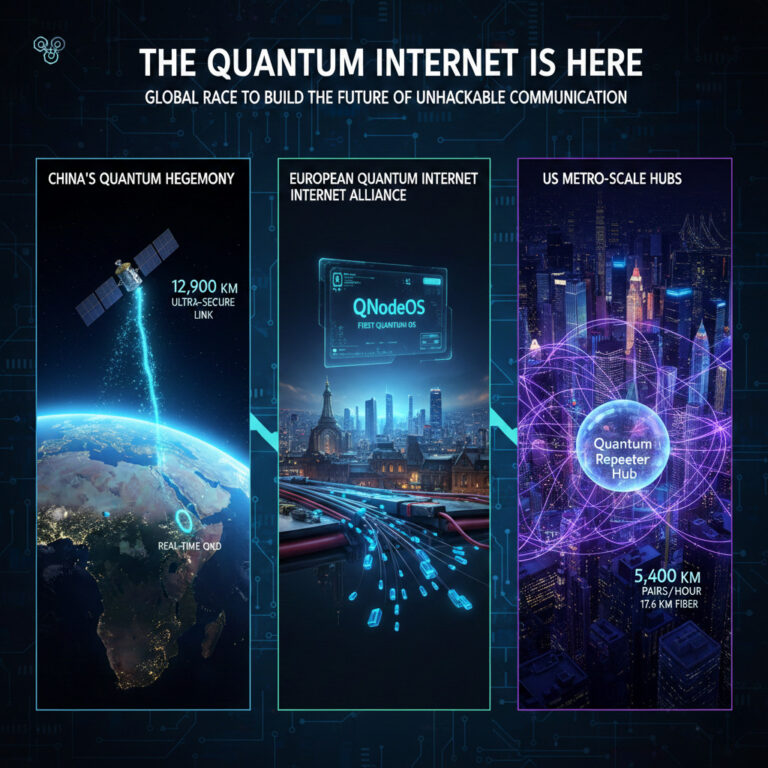
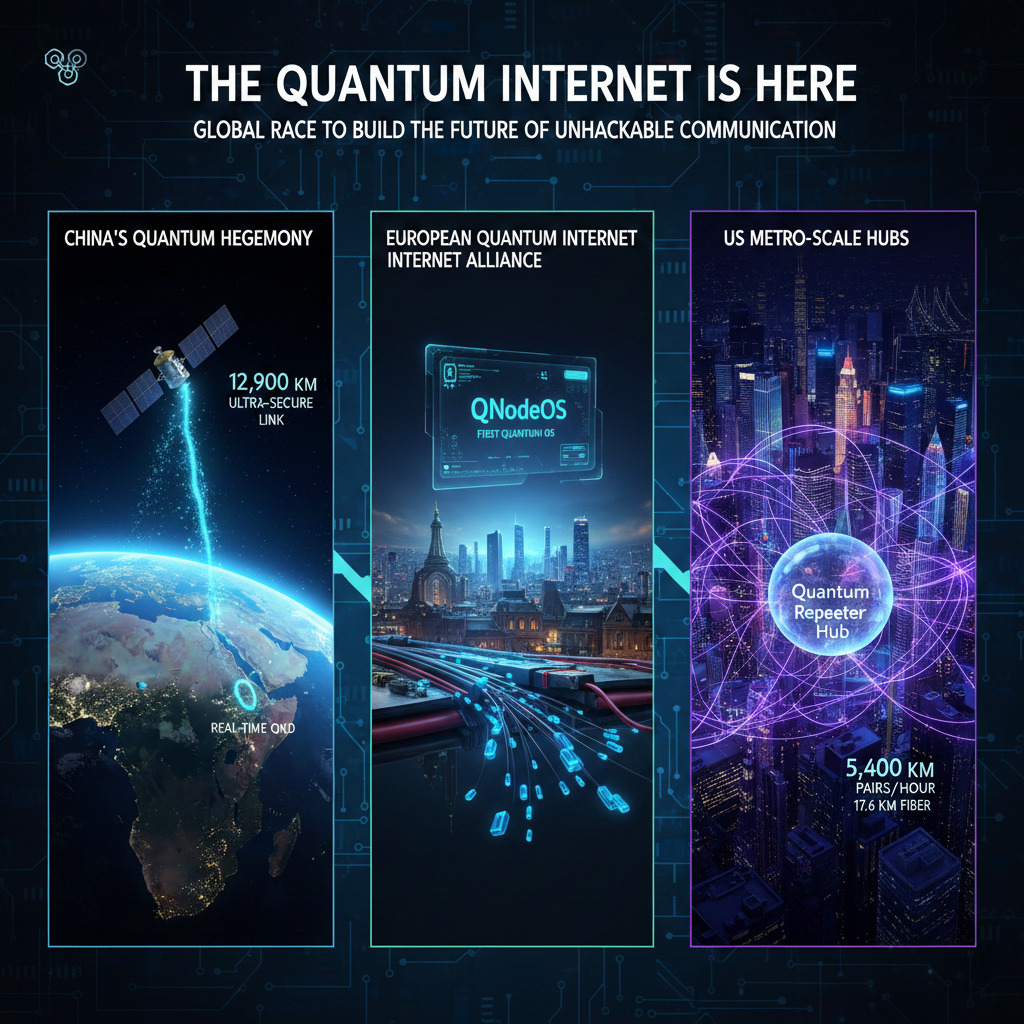
The Big News: In March 2025, Chinese scientists, in partnership with South Africa, achieved a monumental feat: establishing an ultra-secure quantum link spanning an incredible 12,900 kilometers using their new Jinan-1 microsatellite.
Why this matters:
-
Real-Time Security: Unlike earlier experiments that took days to establish quantum “keys,” Jinan-1 demonstrated real-time Quantum Key Distribution (QKD), making instant, unbreakable encryption a reality over vast distances.
-
Miniaturization is Key: The Jinan-1 weighs a mere 100 kg – six times lighter than Micius. This smaller, cheaper design means we’re closer to seeing “quantum constellations” of satellites providing global, secure coverage. Think of it as GPS for data security.
Europe’s Terrestrial Backbone: Building the “Quantum OS”
While China focuses on the skies, Europe is busy building the fiber-optic “quantum roads” on Earth. The European Quantum Internet Alliance (QIA) is leading the charge in developing the crucial software and hardware to connect quantum devices across cities and nations.
Operating System for the Quantum Age: A major milestone in March 2025 was the launch of QNodeOS. This isn’t just code; it’s the world’s first operating system specifically designed for quantum networks. It’s like Windows or iOS, but for quantum computers and communication nodes, allowing developers to create quantum applications without needing a PhD in quantum physics.
Protecting the Continent: The EU’s European Quantum Communication Infrastructure (EuroQCI) is also rapidly expanding. Its primary goal? To protect sensitive governmental and critical infrastructure data across all 27 member states, future-proofing their most vital communications against even the most powerful future supercomputers. The satellite quantum internet market is now projected to hit $1.82 billion by the end of 2026, highlighting the immense economic and strategic stakes.
The US Approach: Metropolitan Quantum Hubs
The United States is taking a slightly different but equally vital approach, focusing on creating “Metro-Scale Networks” – essentially, creating quantum “spokes and hubs” within major cities to enable distributed quantum computing.
Manhattan’s Quantum Network: In a significant breakthrough in February 2026, a collaboration in New York City (dubbed “GothamQ”) successfully demonstrated high-speed entanglement swapping over 17.6 km of existing commercial fiber optic cable.
Record-Breaking Efficiency: They achieved an astonishing 5,400 entanglement “pairs” per hour – nearly 10,000 times more efficient than previous attempts. This proves that quantum networks don’t need entirely new infrastructure; they can leverage what we already have, accelerating deployment within urban centers.
The Enduring Challenge: The Quantum Repeater
Despite these incredible advances, one major technical hurdle remains: the Quantum Repeater. Unlike a standard internet booster that just amplifies a signal, a quantum repeater must capture, store, and re-transmit delicate quantum information without disturbing it. Imagine trying to catch a snowflake, perfectly preserve its unique structure, and then instantly send an identical one to a distant friend – it’s incredibly difficult.
Progress is Happening: However, research in 2025 has boosted entanglement success rates from a measly sub-1% to over 70% by using more precise “noise-free” photon sources. Simulations now suggest that these memory-based repeaters, placed every 50-100 km, could theoretically support a 10,000 km terrestrial quantum network within 3-5 years.
What Does This Mean for You?
Don’t expect a quantum phone in your pocket next year. The initial impact of the Quantum Internet will be felt behind the scenes:
-
Ultra-Secure Communication: Your bank, government, and critical infrastructure will use these networks to generate “unbreakable” encryption keys. This means that even if sophisticated hackers steal your data today, they will never be able to decrypt it, no matter how powerful their future quantum computers become.
-
Distributed Quantum Computing: Instead of one massive quantum computer, cities will host interconnected quantum processors that can work together, tackling problems far beyond the reach of today’s supercomputers.
-
Future-Proofing: The goal is to create a digital world where our most sensitive information is inherently safe from any known (or future) computational attack.
The race for the Quantum Internet isn’t just a scientific pursuit; it’s a strategic imperative shaping national security, economic power, and the very future of digital communication. The once-distant dream is rapidly becoming a tangible reality, bit by entangled bit.
About the Author