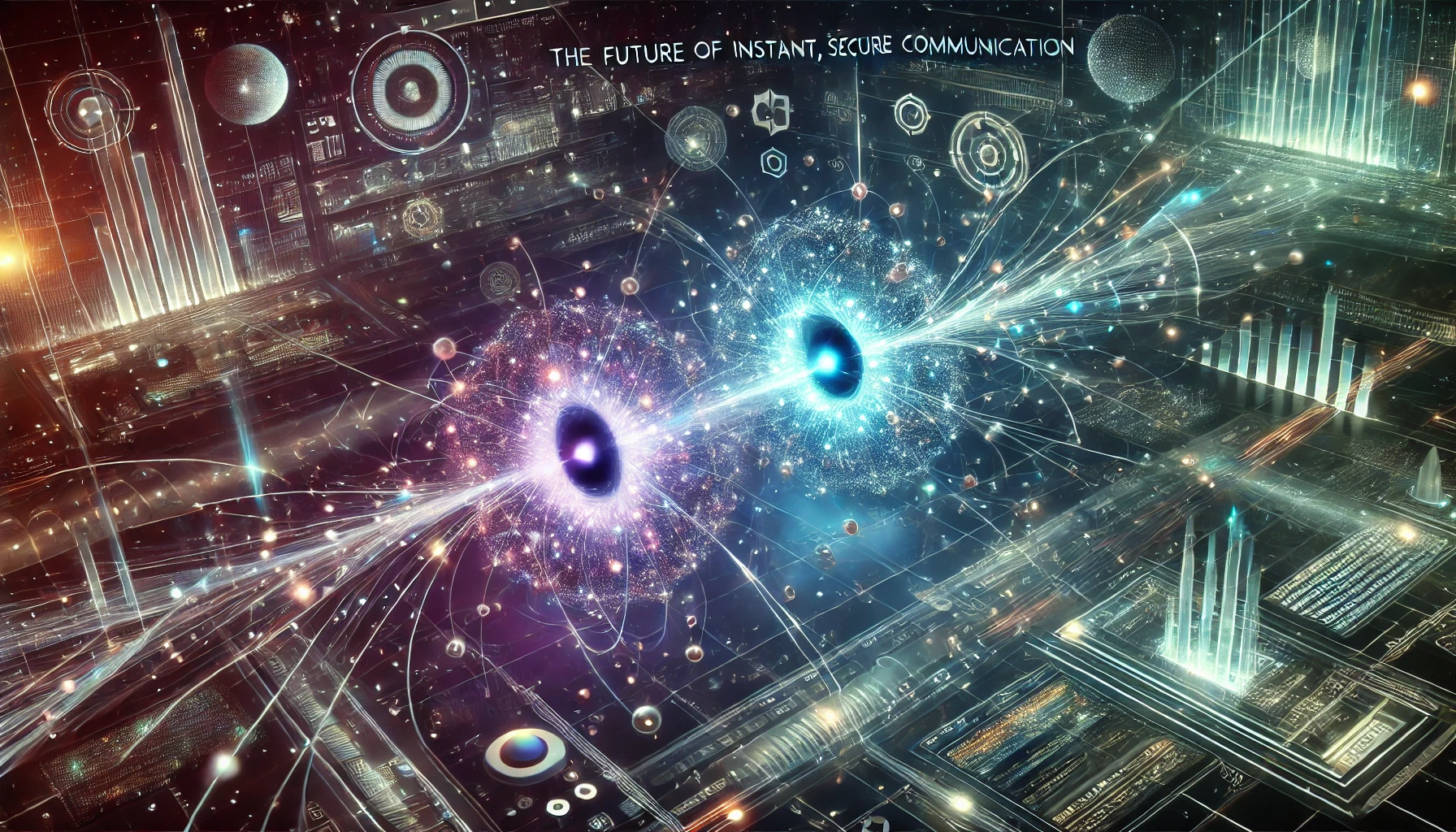
Harnessing Subatomic Particles’ Properties for Faster-than-Light Communication Networks
Introduction
Imagine being able to send a message to a friend on the other side of the world in mere seconds, or even across vast distances, such as from Earth to Mars, in a fraction of a second. Sounds like science fiction, right?
But what if we told you that scientists are working on making this a reality using quantum entanglement communication systems? Harnessing subatomic particles’ properties for faster-than-light communication networks is an area of research that has the potential to revolutionize the way we communicate with each other.
What is Quantum Entanglement?
Quantum entanglement is a phenomenon in which two or more particles become connected in such a way that the state of one particle can instantaneously affect the state of the other, regardless of the distance between them.
-
Subatomic Level: This effect occurs at the smallest scales of matter.
-
The Analogy: Think of it like a pair of connected dancers – if one dancer spins around, the other will spin around too, even if they’re on opposite sides of the stage.
How Does Quantum Entanglement Enable Faster-than-Light Communication?
In 2016, a team of scientists from the University of Innsbruck successfully demonstrated the use of quantum entanglement for secure communication over 16 km (10 miles) in a laboratory setting.
-
The Process: They used Quantum Key Distribution (QKD) to encode a message onto a photon and transmitted it to a receiver.
-
The Result: The receiver used the entangled photon to decode the message, which was then verified to be secure.
-
The Key Benefit: Any attempt to measure or manipulate one particle will instantly affect the other. This means if someone tries to intercept the message, it is immediately detectable, and the communication is compromised.
A Viable Alternative to Traditional Networks?
Traditional communication networks rely on electrical signals or radio waves. However, these are subject to degradation and interference over long distances, leading to errors and lost data. Quantum systems offer a potential solution:
-
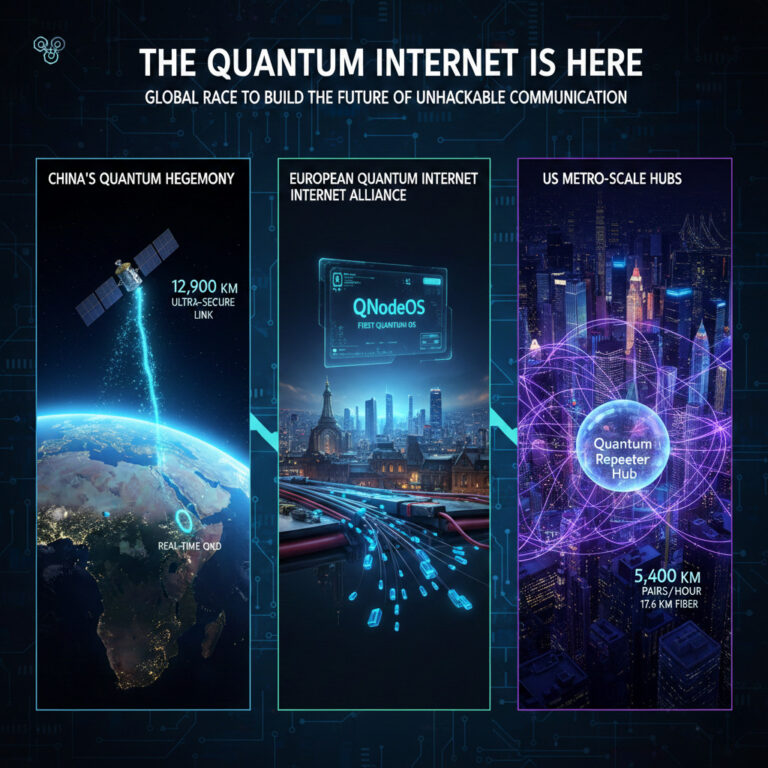
Real-World Success: In 2019, the University of Science and Technology of China demonstrated secure communication over 1,200 km (750 miles) using a satellite.
-
The Goal: This breakthrough has sparked interest in exploring these systems for secure and instantaneous communication over planetary distances.
Potential Applications and Benefits
Quantum entanglement communication systems have numerous potential applications:
-
Secure Communication: Offers an unprecedented level of security against eavesdropping.
-
Instantaneous Messaging: Revolutionizing communication speed across vast global distances.
-
Space Exploration: Enabling reliable communication between spacecraft and Earth, crucial for mission control.
-
Faster-than-Light Travel: While still science fiction, the research into these systems opens doors to exploring FTL concepts.
Challenges and Limitations
Despite the potential, several hurdles remain:
-
Scalability: Precise control over entangled particles becomes increasingly difficult as distance increases.
-
Interference: Systems are sensitive to environmental noise, which can compromise reliability.
-
Quantum Decoherence: Fragile quantum states can be lost due to interactions with the surrounding environment.
Key Takeaways
-
Quantum entanglement systems harness subatomic properties to explore faster-than-light communication possibilities.
-
These systems offer unprecedented levels of security and speed.
-
While challenges like decoherence and scalability exist, the benefits make this one of the most exciting areas of modern research.
About the Author





1 thought on “Quantum Entanglement: The Future of Instant, Secure Communication”
Comments are closed.